

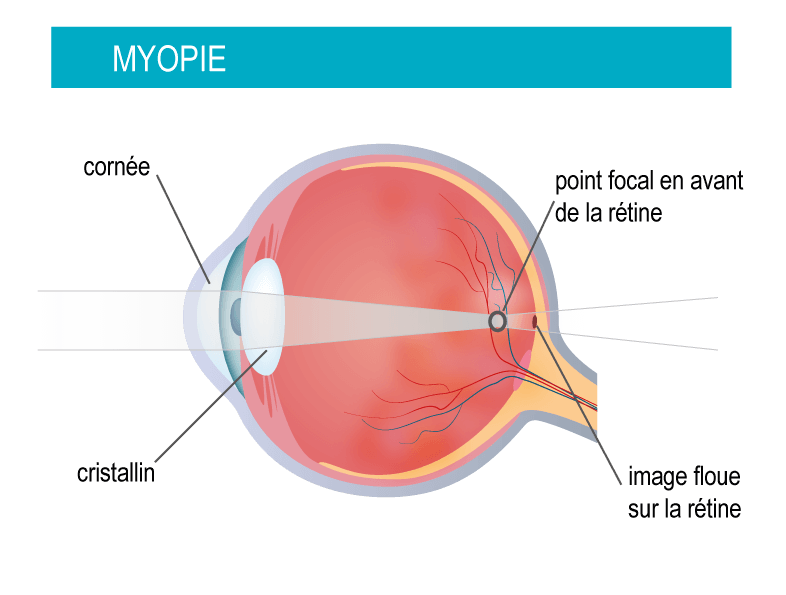
Myopia is a common eye condition in which the image seen by the eye is focused before reaching the retina at the level where it should be, resulting in a blurry image.
Myopia can be divided into two main categories: refractive and axial.
Refractive myopia: is due to the eye’s focusing power being abnormally strong.
Axial myopia: the most common cause, is due to the axial length of the eye being too great, measured from the cornea to the back of the eye.
Studies show that the eye dynamically adjusts its axial length and optical power to maintain a clear image during growth and development. If this self-regulating process is disrupted, the eye can elongate disproportionately, leading to axial myopia.
The process and progression of myopia follow a typical pattern, with normal vision at a young age. Starting in school age, myopic shift and a rapid increase in myopia begin and continue until the end of adolescence. High myopia is associated with a significantly increased risk of retinal problems, including retinal detachment, glaucoma, and cataracts at a young age. These eye diseases increase the risk of severe visual impairment.
Epidemiology
Myopia is an extremely common eye disease worldwide.
The percentage of myopic people in Asian populations varies from 37% to 60%.
Myopia is estimated to affect approximately 25 to 33% of adults in the United States and Western Europe, with a 66% increase in the prevalence of myopia over a 30-year period.
Risk Factors
Ethnicity
Ethnicity has been studied as a risk factor for the progression of myopia.
Internationally, the annual rate of myopia progression in Singapore has been reported at -0.80 diopters per year, while Caucasian European ethnicities report progression rates closer to -0.50 diopters per year. Studies have also shown that Caucasians take the longest to achieve stabilization (16.32 years).
Age
The strongest risk factor for the progression of myopia is having myopia at a young age, especially before 6 or 7 years old. Not only is the final myopia greater in this group, but the progression and lengthening of the axial length are also more rapid.
Parental Myopia
Several studies have shown that parental myopia, even in just one parent, increases the risk of myopia in children. It has even been reported that there is a more than sixfold increased risk of developing myopia if both parents are myopic.
Parental myopia is not only a risk factor for myopia, but also a risk factor for the progression of myopia in children.
Gender
The data are contradictory when assessing sex predisposition to myopia. The COMET study showed no difference between men and women.
Environmental factors
Several studies have been conducted to examine various environmental and non-genetic factors that may play a role in the development of myopia. The amount of close work, such as reading or using portable electronic devices, performed by a child during the day has shown little or no association.
Numerous studies have shown that time spent outdoors is protectively associated with myopia.
The results demonstrated that increasing time spent outdoors reduces the risk of developing myopia by 2% for every hour spent outdoors per week. This offers a practical solution for myopia prevention, along with the numerous other health benefits associated with outdoor activities.
Treatments
People with myopia have several options available to regain clear distance vision.
1. Glasses
For most people with myopia, glasses are the first solution offered, given the young age at diagnosis. Depending on the degree of myopia, you might only need to wear glasses for certain activities, such as watching a movie or driving a car. If you are very nearsighted, you might need to wear them all the time.
2. Contact Lenses
For some people, contact lenses offer clearer vision and a wider field of view than glasses. However, because contact lenses are worn directly on the eyes, they require proper evaluation and care to protect eye health from serious infections that can result from wearing them.
3. Laser vision correction
Laser procedures such as Femtolasik are definitive solutions for myopia in adults.
A laser beam reshapes the cornea to compensate for myopia.
The degree of myopia that LASIK can correct can be as high as -8 diopters, but it is limited by the amount of corneal tissue that can be safely removed. To do this, a portion of the outer corneal surface is lifted and folded back to expose the inner tissue. A laser then removes the precise amount of corneal tissue needed to reshape the eye. The outer tissue flap is then repositioned to heal.
Other refractive surgery procedures
People whose corneas are too thin for laser procedures may benefit from surgical correction of their myopia.
Our ophthalmologists are able to implant small lenses with the desired optical correction in your eyes. The implant can be placed directly in front of the natural lens (phakic intraocular lens implant), or the implant can replace the natural lens (clear lens extraction with intraocular lens implantation).
If you are nearsighted, you can benefit from a variety of options to correct your vision. Our ophthalmologists at Oculus eye centers will help you choose the treatment that best suits your visual needs and lifestyle.